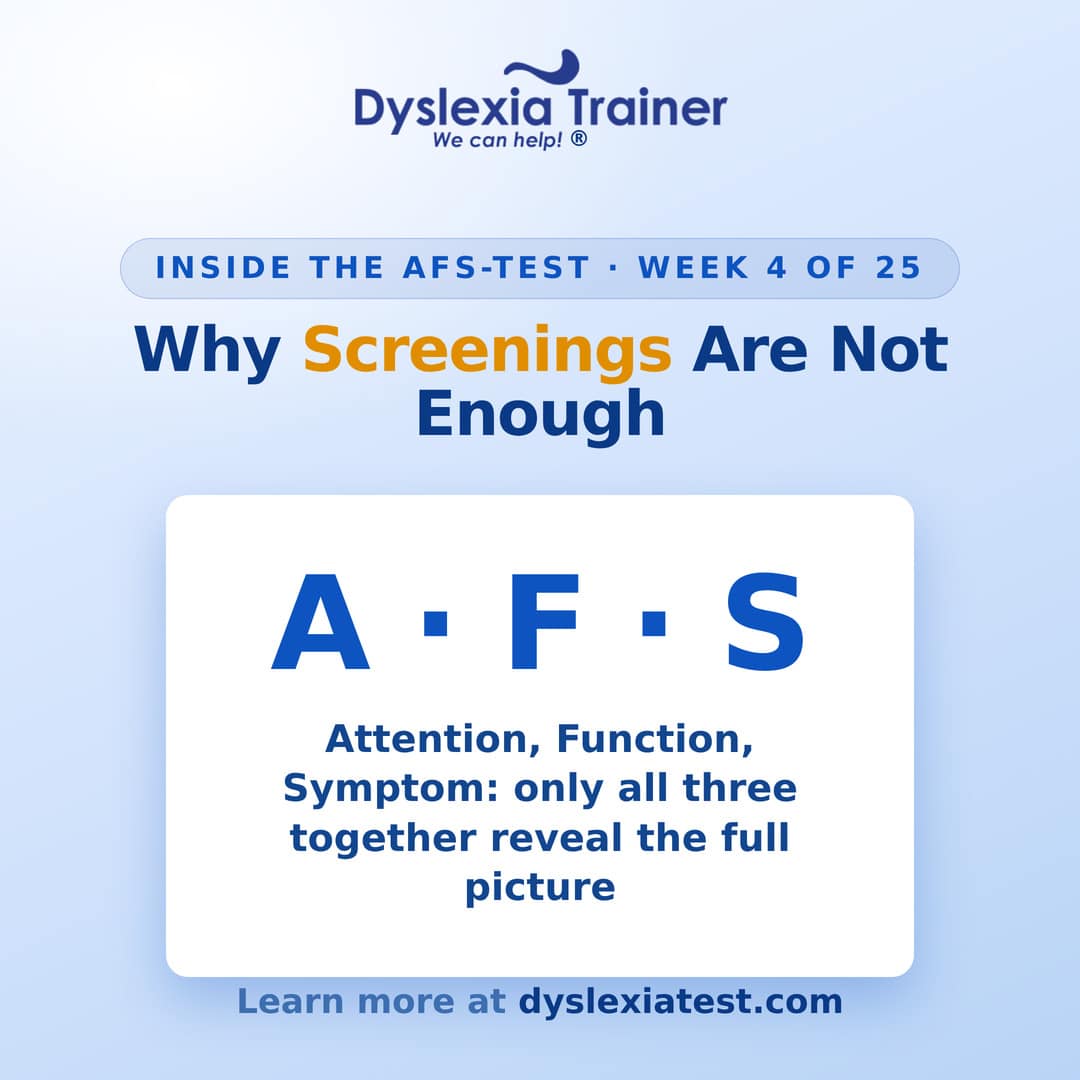
Every Wednesday, we take you inside the AFS-Test, the standardized assessment that allows Certified Dyslexia Trainers to definitively diagnose and categorize dyslexia and dyscalculia. This is week 4 of 25.
This week: Why Screenings Are Not Enough
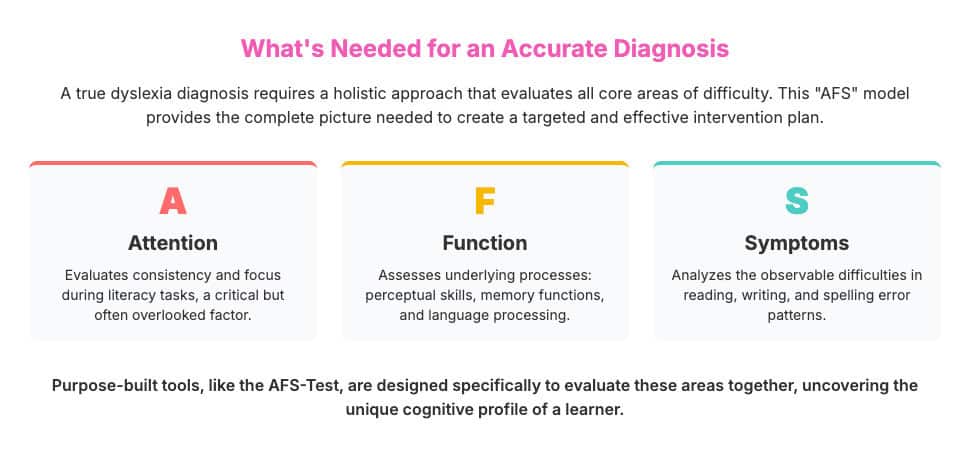
A child can score average on a screening and still struggle every single day. Screenings, reading tests, IQ tests, and phonological assessments each look through one small window, and none of them alone can definitively diagnose and categorize dyslexia. The AFS-Test takes the comprehensive route: it examines the attention span, eight areas of sensory perception, and the concrete error symptoms a child shows when reading, spelling, or calculating. Only when all three areas are tested together does the full picture appear, and with it the right kind of help.
The standardized Attention-Function-Symptom Test has been used worldwide for more than 25 years. It examines the attention span, the sensory perceptions, and the error symptoms of a child, and turns the results into an individualized training plan following the AFS-Method.
Find a Certified Trainer
Certified Dyslexia Trainers conduct the standardized AFS-Test in your area or remotely. Learn more and find a Certified Trainer near you: dyslexiatest.com
You can find all published articles of this series under the tag AFS-Test Series.
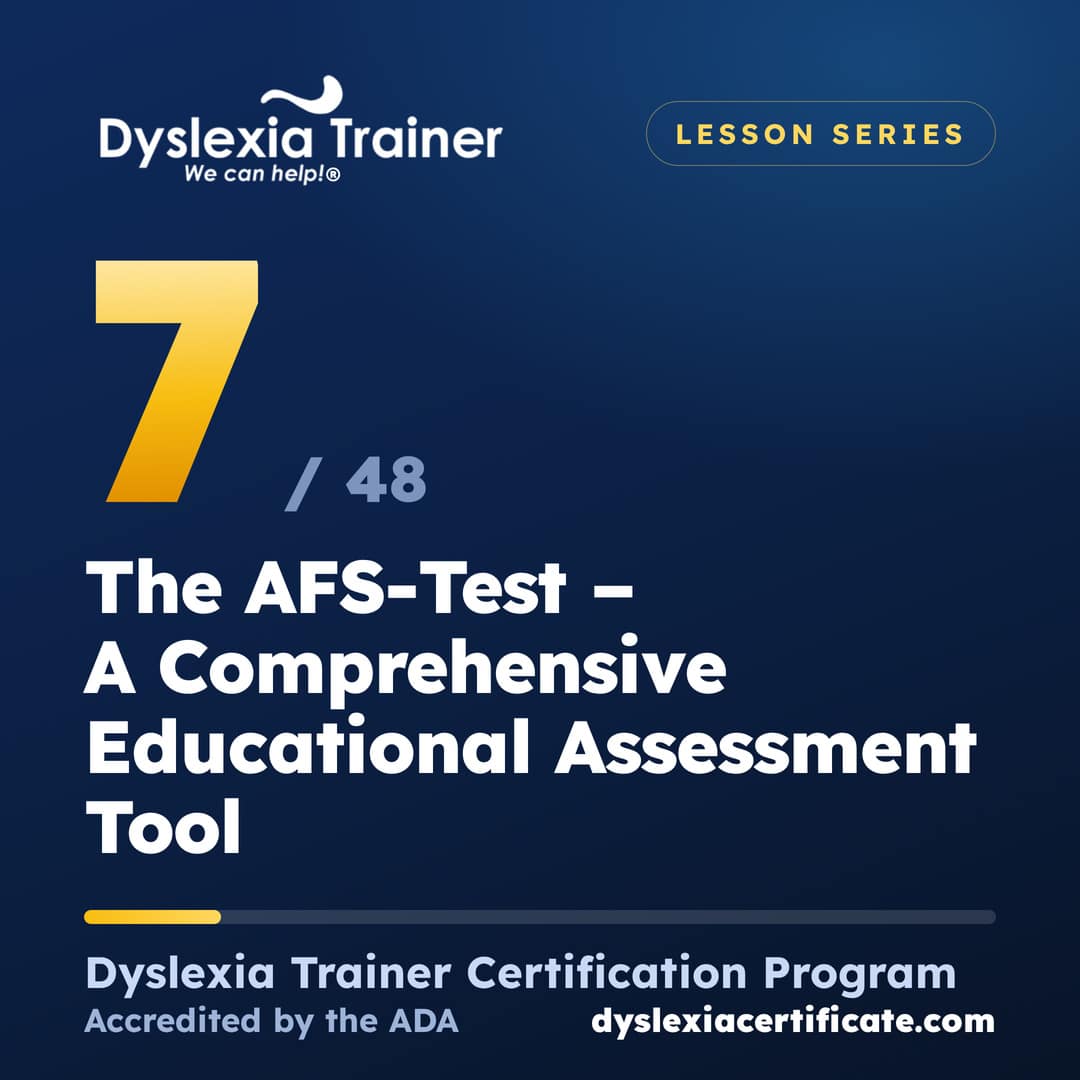
Every Tuesday, we open up one lesson of the Dyslexia Trainer Certification Program here on the blog, all 48 of them, one week at a time. Whether you are a teacher, a parent, or an education professional, this series shows you exactly what certified dyslexia trainers learn, and how the program works from the inside.
This week: The AFS-Test. A Comprehensive Educational Assessment Tool
The AFS-Test (Attention-Function-Symptom Test) is a standardized assessment used worldwide to identify dyslexia and dyscalculia and to plan effective intervention. It evaluates three areas: attention span, the sensory perception abilities underlying reading, spelling, writing, and arithmetic, and the concrete error symptoms a learner shows. This lesson explains its structure and application, and how to turn results into an educational report for parents, teachers, and professionals.
Dyslexia and dyscalculia can present significant challenges for children and adults, often impacting their academic and personal lives. Early identification and targeted support are crucial to helping individuals overcome these difficulties and reach their full potential. The AFS-Test (Attention-Function-Symptom Test) is a comprehensive, standardized assessment tool used worldwide to diagnose and plan effective intervention for those experiencing reading, spelling, writing, or arithmetic difficulties.
This lesson explores the structure and application of the AFS-Test, explaining how it evaluates the key areas associated with dyslexia and dyscalculia. By understanding the test’s methodology and its critical role in developing individualized training plans, educators and specialists can better support learners who require specialized instruction. The lessons concludes with how to write an educational report to summarize your findings for parents, teachers, and other professionals.
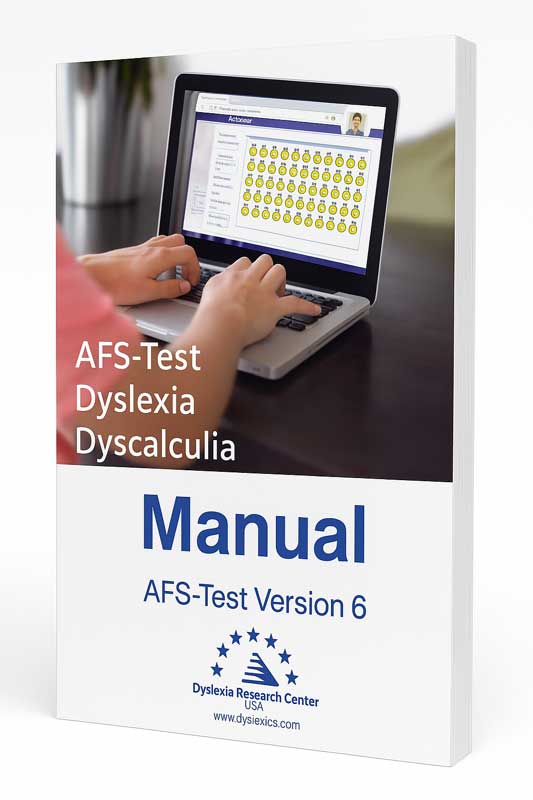
The standardized Attention-Function-Symptom-Test (AFS-Test) is used worldwide by countless educators in their work with people affected by reading, spelling, writing, or arithmetic problems. The test enables parents, teachers, and interested parties to gain better insight into the entire issue, diagnose a dyslexia/dyscalculia definitely, and is also an invaluable tool for training planning. Based on the test results, detailed individual training plans can be created that are tailored to the affected person’s problems.
What you will learn in Lesson 7
The three areas of the AFS-Test: attention, function, symptoms
How the standardized test is conducted and evaluated
From test results to an individualized training plan
Writing an educational report for parents, teachers, and professionals
About the Dyslexia Trainer Certification Program
Since 1997, more than 17,000 dyslexia trainers in 64 countries have been certified. The certification gives you more than knowledge: all the tools you need to actually work with dyslexic children are included as well. Worksheets, training programs, assessment materials, everything ready to use in your practice. You get the whole package.
The program is accredited by the American Dyslexia Association (ADA) and follows the training standards of the International Federation of Dyslexia and Dyscalculia Associations (IFDDA).
Catch up and start free
Lesson 1 is free for everyone. Register in a minute and see the program from the inside: dyslexiacertificate.com
You can find all published lessons of this series under the tag Lesson Series.
Every Wednesday, we take you inside the AFS-Test, the standardized assessment that allows Certified Dyslexia Trainers to definitively diagnose and categorize dyslexia and dyscalculia. This is week 3 of 25.
This week: The Three Levels of Diagnostics
When a child struggles in school, parents often travel a confusing road between teachers, psychologists, and doctors. Diagnostics happen on three levels: the medical, the psychological, and the pedagogical-didactic level. Each answers different questions, and none can replace the others. The pedagogical-didactic level, where the AFS-Test works, is so often the missing piece: it looks at how a child actually reads, writes, and calculates, and what kind of targeted training will help. Only when this level is included does a diagnosis lead directly to support.
The standardized Attention-Function-Symptom Test has been used worldwide for more than 25 years. It examines the attention span, the sensory perceptions, and the error symptoms of a child, and turns the results into an individualized training plan following the AFS-Method.
Find a Certified Trainer
Certified Dyslexia Trainers conduct the standardized AFS-Test in your area or remotely. Learn more and find a Certified Trainer near you: dyslexiatest.com
You can find all published articles of this series under the tag AFS-Test Series.
Every Tuesday, we open up one lesson of the Dyslexia Trainer Certification Program here on the blog, all 48 of them, one week at a time. Whether you are a teacher, a parent, or an education professional, this series shows you exactly what certified dyslexia trainers learn, and how the program works from the inside.
This week: From Errors to Insights. Understanding Symptom Patterns through Error Analysis
Every error a child makes in reading or writing is a window into how their brain processes language. This lesson walks through the full process of error analysis: cataloging errors, recognizing patterns, and distinguishing structural, phonological, and orthographic error types. Trainers learn to link these patterns to visual, auditory, or memory-related challenges, and to turn everyday mistakes into a precise map for targeted support.
Every error a child makes in reading or writing is more than a “mistake”, it is a window into how the brain is processing language. By examining these errors closely, trainers can identify which areas of perception and processing require targeted support.
This lesson walks through the full process: from cataloging errors in the symptom area to analyzing patterns. Trainers will learn to distinguish between structural, phonological, and orthographic errors, and to recognize when these are linked to visual, auditory, or memory-related challenges.
Most importantly, error analysis is not about labeling a child as “weak” or “failing,” but about uncovering the reasons behind their struggles. This understanding can then be transformed into a training plan that restores confidence and builds essential literacy skills.
What you will learn in Lesson 6
How to catalog reading and writing errors systematically
Structural, phonological, and orthographic error types
Linking error patterns to visual, auditory, and memory challenges
Turning everyday mistakes into a targeted support plan
About the Dyslexia Trainer Certification Program
Since 1997, more than 17,000 dyslexia trainers in 64 countries have been certified. The certification gives you more than knowledge: all the tools you need to actually work with dyslexic children are included as well. Worksheets, training programs, assessment materials, everything ready to use in your practice. You get the whole package.
The program is accredited by the American Dyslexia Association (ADA) and follows the training standards of the International Federation of Dyslexia and Dyscalculia Associations (IFDDA).
Catch up and start free
Lesson 1 is free for everyone. Register in a minute and see the program from the inside: dyslexiacertificate.com
You can find all published lessons of this series under the tag Lesson Series.
Every Wednesday, we take you inside the AFS-Test, the standardized assessment that allows Certified Dyslexia Trainers to definitively diagnose and categorize dyslexia and dyscalculia. This is week 2 of 25.
This week: 3 Children in Every Classroom
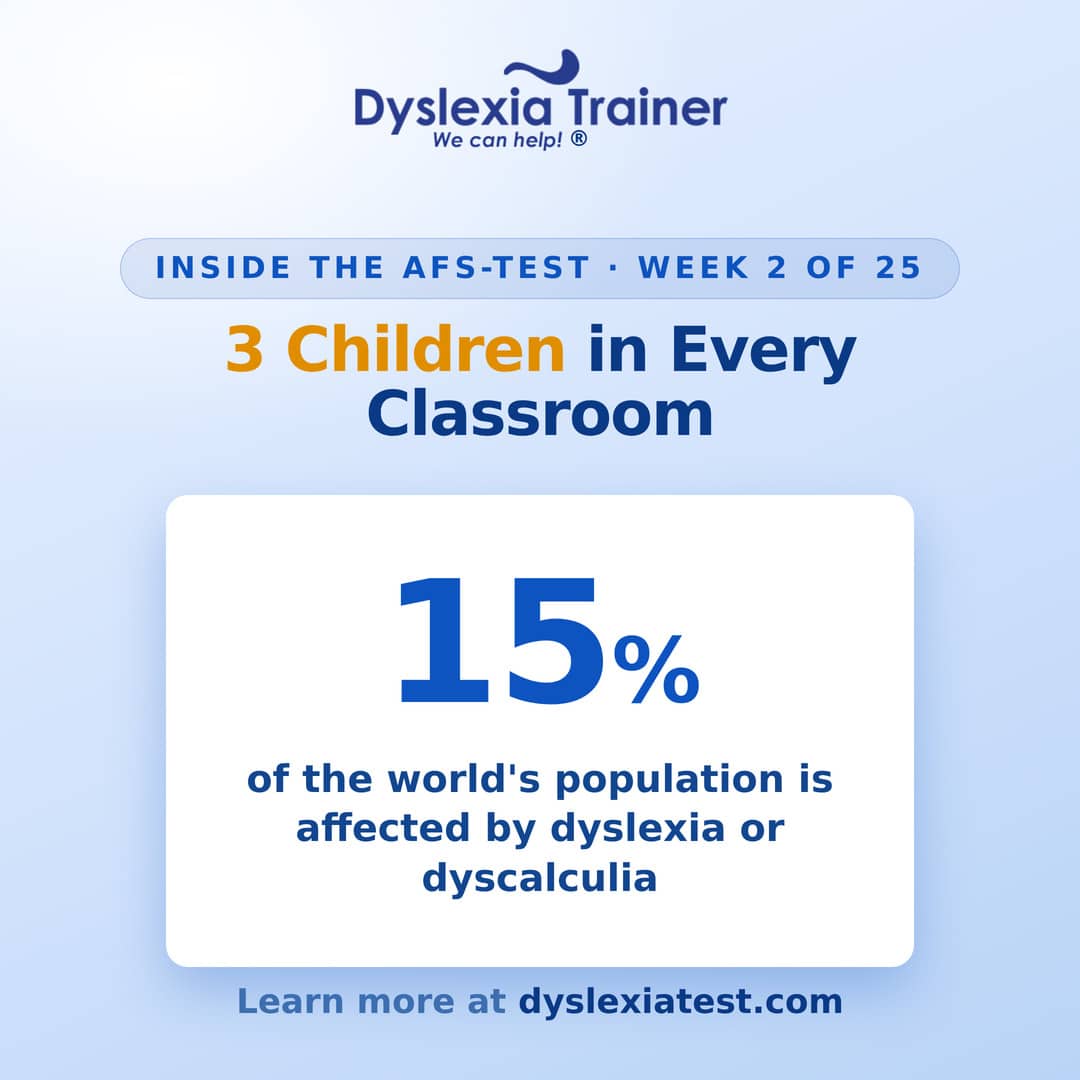
It is estimated that about 15 percent of the world’s population is affected by dyslexia or dyscalculia. In a class of 20 students, that can mean 3 children who struggle with reading, spelling, or arithmetic even though they are intelligent and motivated. If dyslexia or dyscalculia already runs in the family, the probability of inheriting it is between 60 and 70 percent. These children do not need more pressure or more of the same homework. They need clarity first: a standardized assessment that shows exactly how they perceive and process information.
The standardized Attention-Function-Symptom Test has been used worldwide for more than 25 years. It examines the attention span, the sensory perceptions, and the error symptoms of a child, and turns the results into an individualized training plan following the AFS-Method.
Find a Certified Trainer
Certified Dyslexia Trainers conduct the standardized AFS-Test in your area or remotely. Learn more and find a Certified Trainer near you: dyslexiatest.com
You can find all published articles of this series under the tag AFS-Test Series.
Every Tuesday, we open up one lesson of the Dyslexia Trainer Certification Program here on the blog, all 48 of them, one week at a time. Whether you are a teacher, a parent, or an education professional, this series shows you exactly what certified dyslexia trainers learn, and how the program works from the inside.
This week: Beyond Screenings and Assessments: Why Only Comprehensive Testing Reveals Dyslexia
A child can score average on an achievement test and still struggle every single day. This lesson explains why screenings, reading tests, IQ tests, and phonological assessments alone cannot diagnose dyslexia, and what comprehensive testing has to cover instead. Trainers learn to see what standard instruments miss, and why an incomplete assessment so often leads to the wrong kind of help.
Accurate identification is the foundation of effective dyslexia support, but not all assessments serve the same purpose. Screenings are valuable for highlighting children who may be at risk, but they do not provide a diagnosis and cannot guide an intervention plan.
Similarly, standardized reading and spelling tests, intelligence tests, and phonological assessments are often misused in dyslexia evaluation. These tools were never designed to diagnose dyslexia, and when applied in this way they frequently produce misleading or incomplete results. A child may test “average” on an achievement test while still struggling daily, or may score poorly on an IQ test and be misclassified as having low intelligence rather than dyslexia.
As trainers, it is crucial to understand both the possibilities and the limits of these tools. Recognizing their shortcomings not only prevents misdiagnosis but also ensures that no child is denied the support they need. This lesson introduces the most common screenings and assessments you will encounter in practice, while emphasizing the need for comprehensive evaluation methods that truly reflect the unique profile of dyslexic learners.
What you will learn in Lesson 5
What screenings can do, and where they stop
Why achievement and IQ tests are misused in dyslexia evaluation
What comprehensive testing has to cover
How incomplete assessment leads to the wrong help
About the Dyslexia Trainer Certification Program
Since 1997, more than 17,000 dyslexia trainers in 64 countries have been certified. The certification gives you more than knowledge: all the tools you need to actually work with dyslexic children are included as well. Worksheets, training programs, assessment materials, everything ready to use in your practice. You get the whole package.
The program is accredited by the American Dyslexia Association (ADA) and follows the training standards of the International Federation of Dyslexia and Dyscalculia Associations (IFDDA).
Catch up and start free
Lesson 1 is free for everyone. Register in a minute and see the program from the inside: dyslexiacertificate.com
You can find all published lessons of this series under the tag Lesson Series.
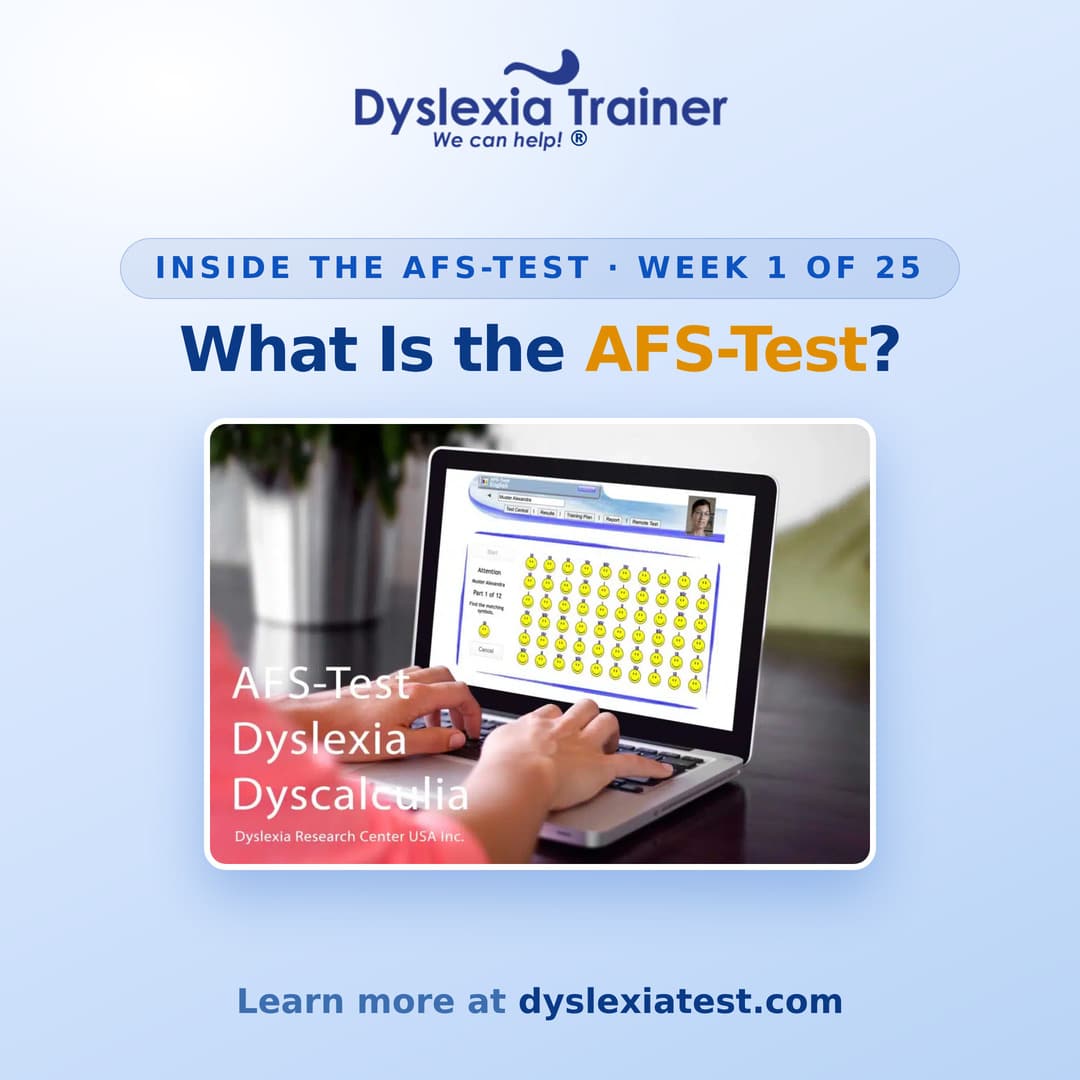
Every Wednesday, we take you inside the AFS-Test, the standardized assessment that allows Certified Dyslexia Trainers to definitively diagnose and categorize dyslexia and dyscalculia. This is week 1 of 25.
This week: What Is the AFS-Test?
Do you suspect dyslexia or dyscalculia? The AFS-Test (Attention-Function-Symptom Test) is a standardized, comprehensive pedagogical assessment that has been used worldwide for more than 25 years. It allows Certified Dyslexia Trainers to definitively diagnose and categorize dyslexia and dyscalculia by looking at the three areas where they show: the attention span, the sensory perceptions, and the symptoms (errors) a child makes when reading, spelling, or calculating.
Over the next 25 weeks, we will walk you through every part of the test: the attention test, all eight sensory perception areas, the symptom tests for reading, spelling, and arithmetic, and everything that happens after testing, from the detailed evaluation to the educational report and the individualized training plan.
About the AFS-Test
The standardized Attention-Function-Symptom Test has been used worldwide for more than 25 years. It examines the attention span, the sensory perceptions, and the error symptoms of a child, and turns the results into an individualized training plan following the AFS-Method.
Find a Certified Trainer
Certified Dyslexia Trainers conduct the standardized AFS-Test in your area or remotely. Learn more and find a Certified Trainer near you: dyslexiatest.com
You can find all published articles of this series under the tag AFS-Test Series.
Every Tuesday, we open up one lesson of the Dyslexia Trainer Certification Program here on the blog, all 48 of them, one week at a time. Whether you are a teacher, a parent, or an education professional, this series shows you exactly what certified dyslexia trainers learn, and how the program works from the inside.
This week: Understanding Dyslexia Diagnostics: Levels, Procedures, and Case Histories
When a child struggles in school, parents often face a confusing journey between teachers, psychologists, and doctors, each looking at the problem from a different angle. This lesson brings order to that confusion: it explains the three diagnostic levels, what each one can and cannot tell you, and why the pedagogical-didactic level is so often the missing piece. Trainers learn to read case histories and to recognize when behavior is a consequence of years of being overwhelmed, not the cause of the problem.
When a child struggles with reading, writing, or arithmetic, parents often feel overwhelmed and unsure where to turn. As a result, their first point of contact may be a teacher, a psychologist, or a medical doctor, each of whom approaches the problem from a different angle. This can lead to confusion, conflicting explanations, and long diagnostic journeys that may overlook the most important level of support: the pedagogical-didactic level. To understand the child’s real needs, certified dyslexia trainers must be familiar with all three diagnostic levels and the role each one plays in assessing learning difficulties.
In many cases, behavioral symptoms such as restlessness, avoidance, frustration, or inattentiveness are interpreted as the cause of school difficulties, when in reality these behaviors often emerge only after years of being overwhelmed. Misinterpretation can lead to unnecessary psychiatric labels or medical treatments while the child’s underlying difficulties with sensory perception, attention, and symbol processing remain unaddressed. This lesson helps trainers distinguish between symptoms rooted in genetic predisposition (primary dyslexia/dyscalculia), symptoms caused by lack of recognition and repeated failure (secondary dyslexia/dyscalculia), and acquired reading/spelling or arithmetic differences caused by external life events.
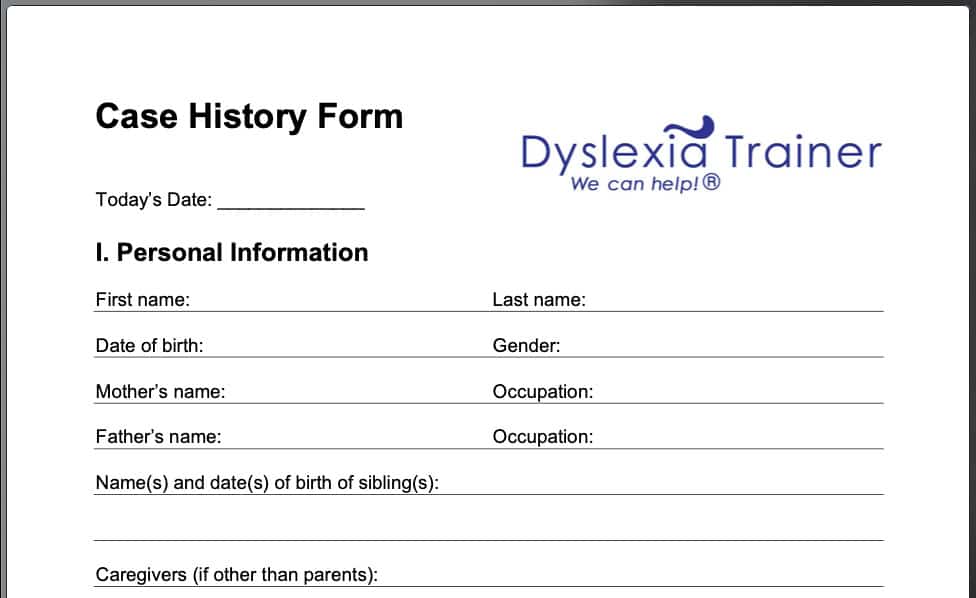
To support families effectively, trainers must know how to conduct a proper case history interview, interpret testing results, and communicate findings clearly and compassionately. Starting with this lesson 4 and continuing with lessons 5 through 7, the focus is to equip trainers with a complete diagnostic roadmap: from the first conversation with parents, to testing, to analysis, to planning targeted interventions. By understanding the three diagnostic levels, and by staying anchored in the educational-didactic perspective, you can guide families toward the right support while avoiding unnecessary detours.
What you will learn in Lesson 4
The three diagnostic levels and what each one can tell you
How to work with case histories
Why behavior problems are often the consequence of school struggles, not the cause
When to involve teachers, psychologists, or physicians
About the Dyslexia Trainer Certification Program
Since 1997, more than 17,000 dyslexia trainers in 64 countries have been certified. The certification gives you more than knowledge: all the tools you need to actually work with dyslexic children are included as well. Worksheets, training programs, assessment materials, everything ready to use in your practice. You get the whole package.
The program is accredited by the American Dyslexia Association (ADA) and follows the training standards of the International Federation of Dyslexia and Dyscalculia Associations (IFDDA).
Catch up and start free
Lesson 1 is free for everyone. Register in a minute and see the program from the inside: dyslexiacertificate.com
You can find all published lessons of this series under the tag Lesson Series.
For more than 25 years, the standardized AFS-Test has been the pedagogical assessment behind individualized dyslexia and dyscalculia training worldwide. Developed by Dr. Astrid Kopp-Duller, the test allows Certified Dyslexia Trainers to definitively diagnose and categorize dyslexia and dyscalculia.
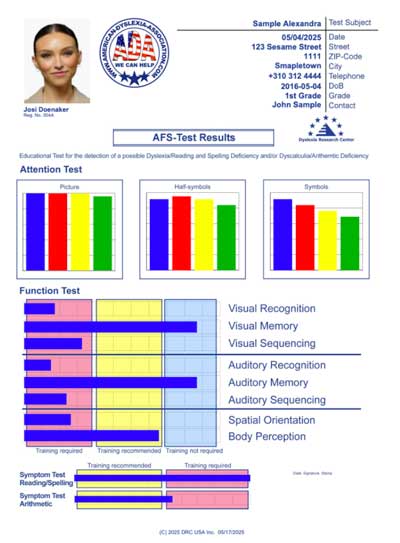
AFS stands for Attention, Function, and Symptom, the three areas in which dyslexia and dyscalculia show. The test examines the attention span when working with symbols, eight sensory perception areas (visual recognition, visual memory, visual sequencing, auditory recognition, auditory memory, auditory sequencing, spatial orientation, and body perception), and the concrete error symptoms a child makes when reading, spelling, or calculating.
Unlike screenings that look through one small window, the AFS-Test takes the comprehensive route. The results are turned into a detailed graphical evaluation, an educational report, and an individualized training plan following the AFS-Method, so training starts exactly where the child needs support.
The AFS-Test is available exclusively to Certified Dyslexia Trainers accredited by the American Dyslexia Association (ADA). This way, every test is conducted and interpreted by a qualified professional, in person or remotely.
A long-term study conducted between 2001 and 2006 with 3,370 participants confirmed the effectiveness of the AFS-Method: 85 percent of the participants continuously improved their reading, spelling, and arithmetic skills over the two-year observation period.
“Parents do not need another label. They need a starting point,” says Dr. Livia R. Pailer-Duller, Director of the Dyslexia Research Center USA. “The AFS-Test shows precisely how a child perceives and processes information, and turns that knowledge into training that measurably works.”
The test is currently available in English, Spanish, French, German, Italian and a dozen other languages, so children can be tested in the language they learn in.
The value of a standardized assessment is easiest to see when none was ever made. When Charles Spencer said in 2026 that his sister Diana, Princess of Wales, had been dyslexic, there was nothing to check the claim against except memory. That case is worth reading.
Educators who want to conduct the AFS-Test themselves can become Certified Dyslexia Trainers through the Dyslexia Trainer Certification Program: 48 self-paced lessons, offered since 1997, with more than 17,000 trainers certified in 64 countries. The program is accredited by the ADA and follows the training standards of the International Federation of Dyslexia and Dyscalculia Associations (IFDDA). Lesson 1 is free at dyslexiacertificate.com
Find a Certified Dyslexia Trainer and request an AFS-Test at dyslexiatest.com
As an Amazon Associate I earn from qualifying purchases.